Story for Young Readers

In a response to an open plea from a youth-oriented SF magazine’s editor, I wrote a story about a boy and the alien that possessed his brother.  Not the most original of ideas, but it was for kids.  As I wrote, new twists on old ideas came to me and found their way to the page.  Now I have two problems.

First, the story is too long for the market that inspired it.  The market caps at 2000 words and this story is just over 2300.  I could probably cut a few hundred words if I wanted to, but I’m pretty sure it would weaken the story.  After all, it’s not the plot that’s special, it’s the relationship between the brothers (even though one of them is not technically there).

Then there’s the other problem: I think this story is too good to start with this particular market.  This market offers only token payment and will have minimal exposure value.  I like the market and the people who run it, but I am trying to establish myself as a professional.

I may try the story in some non-genre youth-oriented publications, maybe Boys’ Life or Cricket.  I need to look up their guidelines first.  I may also try Black Gate (though I think they may be closed to submissions right now) or some other zines that insist their demographic begins with preteens.  It might prove a futile endeavor, but it would be a shame to sell a story for pennies when it might have been worth something.

I’ll probably drop it in the Critters queue while I wait for responses.  I’m having some trouble with the title: “Brother Goo or Why I Threw My Brother in the Ocean” is what I have right now.  Old school “or” format.  Unfortunately I feel like the first sounds like mucus and the second gives away too much.  I may just try “Brother Goo” and see how it is received.  Look at that, I made a decision right here in the middle of my blog and you were here to witness it.  Momentous.

-Oso

UPDATE: I checked out some of those guidelines.  Boys’ Life has a 1500-word limit.  Cricket‘s is 2000.  I went back through the story and trimmed it down to 1990 (the last cut I made was a full paragraph).  I probably could have left a little more in there.  I’ll reread the cut version in a few days, after it’s filtered out of my memory some, then maybe send it to Cricket.  It could still make the rounds of the standard genre magazines, but Analog won’t be likely to touch it.  I’ll probably stick to semi-pro markets outside the youth-oriented zines.  Time will tell how it all works out.

Catching Up on Reading as I Drive

Often I hear of urban dwellers using commute time to do their reading: on a train, bus, or subway.  I drive.  There aren’t a lot of options here.  But I still like to spend that time catching up on good books.  Thank heavens for audio books. Let’s face it, listening to a book is not the same as reading it.  It’s a close second, though, particularly an unabridged version.  It can, however, reveal some of your favorite authors’ faults the same way that reading your own work out loud can reveal flaws in your stories.

I have listened to the first five Harry Potter books on tape or disc, though it’s been years.  I wanted to reread them but couldn’t justify the time away from my perpetually growing reading list that I already neglect far too much.  A coworker had the HP audios and I borrowed one.  The performance by Jim Dale is awesome.  His voices are great and his delivery is spot on for the wizarding world.  I consider his performance the industry standard.  If you haven’t heard him, get one of those books and listen.  If I find other books he reads, I may get them just for his voice.  Of course I haven’t gone looking…yet.

More recently I listened to K-PAX by Gene Brewer.  If you’ve seen the movie, you got the gist of the story.  There were differences, but the movie was well done, as was the book.  The novel’s style lends itself well to audio performance.  It was no Jim Dale, but it was good.

nextAt the same time I purchased K-PAX, I bought Michael Crichton’s Next.  Both were in a discount bin at the local bookstore.  I guess I’m about halfway through it.  I’ve never really read Crichton.  I hope his other books are better.  Considering that every version of Next (hardcover, paperback, and audio) were marked way down, I assume it is a sub-par example of his work. It’s extra tough as an audiobook; I keep wanting to flip around to make sure I know which character he’s talking about.  It took five of the thirteen or so discs to get to the main plot.  I’ll keep this example in mind as I write my own novels.
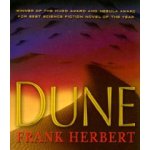
I also bought a book off iTunes, intending to listen on my iPod but it found its home on my school computer.  The book is Dune.  Yes, I am a SF heretic that has never read Frank Herbert’s classic of classics.  I have good reason.  I had a college roommate who watched three different movies EVERY night as he fell asleep: Dune, Waterworld, or The Muppet Movie.  Muppet nights always led to better dreams.  What was more, I married a woman addicted to the David Lynch film.  Just looking at the title sent images of Brad Dourif and Sting.  It was a borderline phobia.

Classic and 100% Sting free.

Anyway, the audiobook was a safer approach for me.  The book is (obviously) much better than the film, though the movie does color many of my mental images.  I’m glad I’m “reading” it this way.  Numerous voices lend their talent to the presentation.  I just absorb a chapter or two while I grade tests or homework during my planning period.  It’s nice, relaxing, efficient.

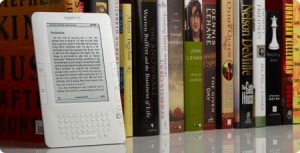
I love audio performances.  The new Amazon Kindle 2 reportedly has an automated “read aloud” option.  Not the same.  I don’t know that I could take more than a page of robo-speak.  Reviews I have seen call the Kindle’s vocal technique “serviceable”.  I’m looking for a voice that adds to the telling, not detracts.  Still, as a writer (even one far from audio contracts), I am concerned  what the auto-read will do to audiobook rights.  Will licensing a book to Kindle reduce the value of the audio rights?  Infringe upon previous rights?  There is a fair amount of discussion out there already about this, most writers groups preferring Amazon include an option to block the audio feature.  Sounds like n inexpensive solution to me, especially if it causes problems with the Kindle acquiring key authors.  Maybe Oprah could get behind the writers’ initiative.  Anyway, I love audiobooks and would hate to see anything inhibit their continued production.

-Oso

Good for reading, but do you want it reading to you?