Very Tiny Countdown

It’s a NaNo countdown…very tiny…? Ah, what do you know from funny?

The outline is officially fully-formed, character intro to denouement, even a 2-page coda at the end.  While chapters are really glorified scenes, each scene is fully structured in its own little outline.  It’s a masterpiece of outlining if I do say so myself.  And, in the spirit of giving credit where it is due, I want to give the credit for this to my word processor, Scrivener.

The layout of Scrivener is very much designed for the outliner.  At first I was turned off by this because, contrary to my recent blog history, I am not an outliner.  I’m a pantser (but not the kind that sneaks up behind you and pulls down your gym shorts).  However, as I learned during last year’s NaNo, writing a novel is not really a pantser’s game.  Some degree of planning and structure is a necessity, though how much and what form varies author to author.  The only novel I ever finished writing was the very first thing I wrote, for which I had an outline (complete with Roman numerals and indents).  Scrivener’s index card system gave me tools with which to brainstorm and organize my thoughts; quite a feat, as anyone who has ever seen my desk can attest.  Moreover, the outlining system gives me the framework to start writing scenes and keep those scenes linked to the respective portion of the outline.  And I can’t wait to get to it.

I have only used Scrivener for one other project before, a very segmented short story entitled “The Scrapper and the Saint Bernard” for the collection Galactic Creatures.  In that story, each index card was a scene in which the main character spoke into his space suit’s recording device. It was 100% dialog, though 95% of the story was him talking to himself or to a mostly inanimate satellite.  (Confused?  Think Cast Away in space.)  Anyway, the story was very experimental in format and I wanted to have a feel for the structure before I tried to write the story; it needed a descent into delirium I had never attempted, and without stage directions.  I embraced the structure and was incredibly happy with the result.  There may well be something to this whole outlining thing.

Still, we’re talking about a sentence or two to structure each thousand words.  A pretty thorough substructure, no doubt, but I still have a whole lot of gaps to fill during the writing process.  And the outline went through some growing pains as each chapter notecard grew into 3-6 notecards.  Chapters split, merged, reorganized, new chapters spawned.  I’d be a fool to think the same won’t happen in the writing process.  And again when I finally reach the editing phase.  This is by far the largest project I’ve ever undertaken and I have done ten times the prep that I’ve put into any other project.  I have no excuse to fail.  So I guess I’d better not.

My goals for the next two days include reacquainting myself with the first few chapters of the outline and condensing my novel into an elevator pitch so I can tell people what the heck I’m writing without robbing them of a half hour.  That may be the biggest challenge of the bunch.

It’s almost here; good luck, WriMos!

Finished my novel…outline

I’ve had 70% of a working outline for my NaNo project for a few weeks, but I just finished sculpting the last few chapters, at least in broad strokes.  The map is drawn, my compass has a heading.  Insert your own cliched metaphor here.  And I’m kind of happy with it.

I’ve known for a while where I was going in a very broad, hand-waving sense.  Now I have a very concrete, hand-waving sense of it.  Next step is to give each of those chapters a point-by-point skeleton.  It’s the most over-wrought outline I’ve ever made, yet I still get to fill in a lot with the writing.

Let’s do a little math here. I currently have 35 chapters planned and most of those should come in around 2-3k words, a few I suspect scraping as much as 5k, so let’s set the average to 3000.  3000 x 35 = 105,000 words.  Ahem.  Yeah, that won’t be finished by the end of November.  And that will be a tough first-novel sale, though it doesn’t seem impossible.  However, I’m (somewhat of a) realist; not all those words will survive the editing apocalypse.  I’m anticipating 95k when the red ink settles, though don’t tie me to that.  I’m giving myself as much permission as possible to expound, be verbose, describe, and generally write like a novelist and not a short story writer.  At the same time, the story is being told through five PoV characters, so each is getting his/her own novella, only diced up and spread through the book chronologically along with the others.  And once characters come together, the story lines bleed into one another.  It is an ambitious project, but I am an ambitious guy I’d like to be an ambitious guy.

There is almost no doubt that the outline will change as I write.  I am comfortable with that and I look forward to it.  And as for the character that I created for a specific purpose but never quite put into the outline…well, she may make a brief appearance and a bloody exit if I truly need her for what I designed her to do.  I’m hoping to just write her out.  There will be enough unpleasant character death as the outline stands, though not quite GRRM standards.

I’m setting myself a moderately soft deadline of Jan. 31 to finish the entirety of the draft.  I really wanted to draw the line at Jan. 1, but there’s way too much happening in December (state tests, end of semester, bitty birthday, X-mas, etc.) to believe in that.  Though I confess, it would be great to have the whole thing submission-ready before ChattaCon (Jan. 25-27).  But finished draft is not submission ready.  But perhaps that makes a better draft deadline…

Anyway, I’m looking at about 72 hours and counting before I can start tapping out prose.  NaNoWriMo, here I come.

Oh yeah, I have three days of work first.  :-/

Armed for Nano

Unlike last year, I am 100% prepped and ready to get underway on my NaNoWriMo novel.  I have a number of great tools and toys to use in my quest for 50,000 words.  Let’s talk about them, in no particular order.

  • WikidPad – I’m using this wiki-style tool to organize my story world.  It would be equally great for organizing research.  The whole idea is about linking topics together in as quick and painless a way as possible.  If I’m writing about Flynn and I need to know what type of gun his mechanized battle suit uses, I can track it down: CharactersBook1>FlyNN>FlynnsMech>WeaPons, each linked to the other in sequence. (Ye, the weird capitalization is part of it.)  Cross-reference heaven.  If I want to look up other members of Willow’s tribe: CharactersBook1>WilloW>SoFari>NotableCitizens.  I confess, building it has been fun and there are a lot of avenues I haven’t developed yet.  If I get to something I haven’t fleshed out, I’ll know that too and can add as needed.  More than anything, this will help prevent those pesky inconsistencies that are so hard to drum out after the fact.
  • Scrivener – I bought this word processing program last year during NaNo, but I really didn’t know how to use it then.  I’m still no expert, but I’ve been using the index card/corkboard to organize my outline.  This is different from my world organization, which is pretty much facts, statistics, relationships.  This is a model for the order of my plot and a bit about what happens in each section.  It’s a pretty detailed outline, I must say: a chapter-by-chapter array with each chapter broken into 3-6 sub-sections.  It’s only though about 66% of the novel so far, but that should be fixed before Halloween.  The way Scrivener works is there’s effectively a separate little document for each of my sub-sections where I write as much or as little as the section requires.  It’s designed for these sub-sections to be scenes, but it doesn’t work out that way in my outline.  Anyway, these all compile into a single document in the end.  It’s got my plot poised and ready for battle.  Wat’s more, I can skip around the story pretty easily if I need to.  Perhaps I’m on a roll writing one character and I want to stay with him/her through writing another chapter despite the next chapter switching to a different scene.  I can do it without worrying about losing my place.  Also a good idea when faced with the opposite — writer’s block.
  • Dragon Naturally Speaking – Okay, I won’t get to use it as much as I might want due to weird words and names, but I fully expect to have stretches of the novel I speak into the computer instead of type.  I’m a really slow typist, so I may go so far as to whip out the headset for a word war at the local write-in, but I doubt it.  Mostly it’ll relieve me when typing gets too rough to bear.  And it’s a toy, which can make the more tedious sections (descriptions, character foreshadowing, etc.) a little easier to power through.
  • Flip Dictionary – This is one of my favorite writing books.  It doesn’t always give me the word I’m after, but it tends to help.  Yes, it’s a glorified thesaurus, but it’s layout is virtually a wiki in itself.  I’m notoriously finding myself stuck on a single word and finding it impossible to think of anything else but that word that’s on he tip of my brain but won’t come.  Flip Dictionary tends to help me get the word (or a better one) and move on.  WARNING: This is not to be used to replace perfectly good words with fancier words, just to get a word down that conveys a meaning that no cluster of wods is quite getting across.  If I need someone to “saunter” and can’t think of the word, I’ll just type “walked slowly and casually” and fix it on edit.  But when I can’t quite get into the same zip code as the word I’m after, FD gets me closer with a few cross-references.  I like it.
  • USB Keyboard – How simple can I get?  Well, sometimes this stupid laptop keyboard is hard to work with.  The computer gets hot or the keys don’t all register well (I’ve had to correct about 20 non-registered keystrokes in this post alone) and I like to have a little more freedom.  Yes, a Bluetooth keyboard would be even more freedom, but I’m cheap and I have a USB keyboard sitting around the house, so I just toss it into the computer bag and have it with me for any excursion-writing I might do.  Trust me, this makes a difference when you’re after 50k.  It’s like having comfortable shoes for a marathon.
  • Sick Day on the 1st – I’ve already put in for November 1st off work.  Let’s face it, I’ll be in no condition to work that day.  So I’ll go to the midnight write-in my local NaNo is having and get a good head start.

That’s about all the tools that come to mind.  Five days and change to go.  Good luck NaNo-ers!

NanoNanoNanoNano…

8 days and some-odd hours until NaNoWriMo (that’s National Novel Writing Month for those unfamiliar).  I’ve already blogged about it recently; this is me expressing my excitement!  I am so ready to take a bite out of the first chapter.  I am tempted to start early…but no.  I am trying to channel that energy into constructive projects like paperbacking my short story collection and powering through an old broken short story between now and November 1st.  I tell you, the anticipation is making me so sick that I might not be able to go to work on the first.  >:-)

If you are also a Nano (Nanite?), feel free to buddy me (Scott W Baker).

Call me old fashioned…

Okay, I did it.  I didn’t intend to, but I did it anyway.  I just finished submitting my e-book collection Baker’s Dozen to be a book-book.  A self-published book, but still a book.  I don’t expect the sales to be any better than the ebook version, but it’s a format I wanted.

Rewind to LibertyCon last summer.  People kept coming by the interview table asking what I had for sale.  I had nothing to show them.  Well, I had coupons and bookmarks to show, but nothing to sell on the spot, nothing to sign for them.  In consumer terms, I had nothing.  I’ve kind of regretted that ever since, and now I’m finally doing something about it.

My plan is to order a batch of 30 before ChattaCon hits in January so I can sell there.  I don’t expect to sell thirty that weekend (not ruling it out), but I’d like to sell enough to cover the price of the order.  After that, each sale will be pure profit.  I’m also considering some sort of coupon code or something so that the buyer of a hard-copy can get the ebook for free.  No sure on that quite yet, but I’m toying with the idea.

The book will be trade paperback.  It will have all the same content as the ebook (I considered bonus content but decided against) with the same cover and a few teasers on the back cover.   I’m using Amazon’s CreateSpace to print the book, a process that has been pretty easy short of the cover design.  I took the $10 plunge to list “Out of Chaos” as the publishing imprint.  So far, I’m happy with the process.  Time will tell how happy I am in the end.


Time Wasting on the go

What do you do when you have a few down minutes someplace random? Sure, I should probably be writing, but let’s face it, you can’t be in a constant state of writer-readiness. So me, I play around on my Android phone.

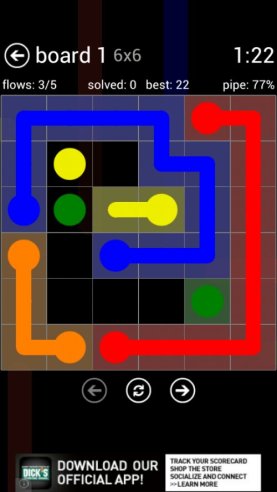
I’ve been there and done that with Angry Birds and 100 Floors. My latest obsessive game is a fairly innocuous-looking game called Flow Free.

At its base, Flow Free (probably just called Flow, but I’m cheap so mine is free) is just a connect-the-dots puzzle game, only you aren’t allowed to cross your own lines. The first few levels of free play (puzzle levels) are pretty simple, but things get tougher as you increase the size of the grid.

imageBut it’s not the free play but the time trial levels I’ve been obsessing over. It consists of a series of the easier puzzles strung together on a timer – 30 seconds, 1 minute, 2 minutes, or 4 minutes. And of course it keeps track of your records.
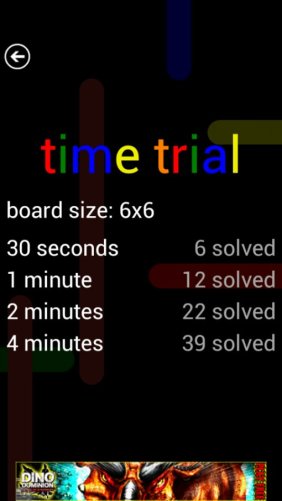
I can’t find other brag-posts of people touting their Flow accomplishments like I find for other games, but here’s mine.

image

Yeah, I’ve got to remember that when I complain about never having enough time to do stuff. Anyway, Flow Free is fun, addictive, simultaneously easy and challenging, and free through Google Play. What more could you want?

How am I going to resist this?

I recently blogged on my discovery of and addiction to the Writing Excuses podcast.  Well, this morning I discovered that the fine folks at Writing Excuses (specifically Brandon Sanderson, Mary Robinette Kowal, Howard Taylor, and Dan Wells) are conducting a one-week writing workshop/retreat called “Out of Excuses“.

Knowing what I know about these fine folks, I suspected the workshop would be in Utah.  It is not.  It’s in Chattanooga, Tennessee.  Yeah, that’s like an hour and a half from where my butt currently sits.

So I need to do one of two things: (a) figure out where to get a thousand bucks (give or take) so I can attend, or (b) find a sufficient excuse to explain to myself why it’s okay that I’m not attending. A roommate would make (a) a more feasible option by reducing the lower bound of the price to $750 (extras will still cost extra, of course).

Don’t get me wrong, this isn’t Clarion or the WotF workshop, but it’s a week to be a writer and to get to know writers.  And write.

Hard to say what my situation will be by June, financially and otherwise, so option (b) will likely fulfill itself via the workshop filling up before I can afford to buy in.  But it’s an option on the horizon that would be pretty frigging awesome.  I’ll be contemplating and brainstorming…