Ever feel brilliant?

Some days I feel like I am a genius.  This usually happens on days where I don’t get a lot of actual writing done.  Today is one of those days.

I was once an outliner, using the whole Roman numeral system and everything, just like they taught me in middle school.  I eventually regressed to a bullet system, but even that is often too rigid for my short fiction.  Now I do almost all of my story planning in freewriting exercises (also something i learned in middle school).  It usually just helps me find character motivations, flesh out plots.  Today it worked a miracle.

Okay, it’s probably not the freewriting.  Only so much of it is even me.  I got my inspiration from, of all places, a reality television show.  The rest came from about a dozen of those writing books that line my bookshelf (many described here).  I kept asking myslf the right questions.  Like what?  The biggest: What human truth am I revealing with this story?  According to Kate Wilhelm’s Storyteller, triviality is a regular problem with stories, even at Clarion.  I suffer that problem a lot.  I am pleased to say that this story isn’t planned to be trivial.  How about that, huh?  (Sorry, watching Leno as I type.)

Other questions: Why do I care?  Who’s viewpoint is the most dramatic?  Why would she do that?  How would I accomplish this or that goal?  It’s all basic stuff, but I finally feel like I’m asking the right questions at the right time.

I realize, this late in the post, that most of you probably don’t care.  I sound kind of like I’m bragging.  Maybe I am.  It has seemed recently that everything I’ve been writing has either slipped out too smoothly or bogged down in attempts  be relevant only to end up monotonous.  People keep telling me that making the Clarion West waitlist this year means I’ll surely make it next year (unless lightning hits Jordan Lapp before June).  But I hadn’t felt like the ideas hitting me had the potential to be any better than “Leech Run” or “Glow Baby”.  This one could be.  I’m excited about my good idea and I’m taking it out on you.

Reality check: I haven’t written the first word yet.  I have my main characters (mother and daughter named Evelyn and Kelby Abrams), an opening scene idea (think the opening of The Great Gatsby set in a CEO’s waiting lounge), a POV (Kelby’s), the antagonist’s motvation, the SF plot points, comuppance, a major foreshadowing element, a few minor characters, and that great human truth that so many of us endure…but they are all ideas in paraphrased forms that may or may not play out in words the way I envision them.  Basiclly, I’ve done the easy part.  Next comes the gruesome act of spewing this into narrative form, followd by the painful art of revision and editing.  It’s like I’m looing at Everest from basecamp praising myself for making it this far.

Still, I am thrilled that my brain has returned to me.  I go through phases like this, where I don’t feel like I’m getting anywhere just to come out of it a long way ahead of where I fell off.  My monkey paw touched the monolith.  Now let’s see what I can do with this bone.
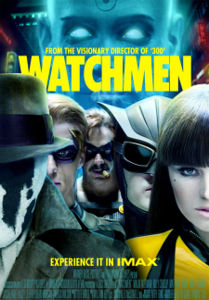
Finally saw Watchmen

209px-posterfeb1aI wanted to rush out opening weekend, but I’m too old for that kind of thing.  Me in a packed theater with a hundred people who could already tell you what they did wrong before the previews started…nope.  Mostly because I couldn’t get a sitter.

Let me preface my opinions with the fact that I have never read the graphic novel.  I have only read blurb comments from other reviewers.  This is 99% my own unbiased theatrical experience.

It was awesome.

This film will stay logged as an example of character development.  Heroes always have dark pasts, but the differences in how they deal with the darkness is stunning.  I will try to stay spoiler-free, so if I reveal something, it’s because it happens early.  Like the Comedian’s death.  It was a stroke of brilliance on someone’s part that a character that dies in the opening sequence can be as vile as you can make him without havng to worry about lost sympathy.  No matter how much I disliked him, I didn’t have to worry about his comeuppance; it already happened.  And his jaded, villainous character was still unquestionably a hero.  The casting for him was excellent.

In fact, all the casting was great.  Ozymandias may have been a little on the model side, but it kind of worked.  The nerdy Nite Owl, the too sexy to be that naked Silk Spectre…but Rorschach stole the show for me.  Hard core to the verge of evil yet held fast to a very personal code.  The subtle elements (like Nite Owl’s problem with…wait, no spoilers) were nicely worked in and believable.

Let’s not forget Dr. Manhattan.  I told my wife I was going to shave my body and paint myself blue for Halloween.  She laughed.  Apparently I lack his physique.  It’s good to know, however, that if I am atomized in some nuclear experiment and come back glowing blue, at least I will be anatomically correct.  No Ken dolls here.  Anyway, his character was interesting in his alienness, especially the struggle to maintain humanity.  I think that could have been done better (read: more subtly), but it was pretty good as it was.  He maintains concern (at least feigned) for humanity while losing his ability to connect with anyone human-to-human.  No more on that, but again, this is all setup, not major storyline developments.

The film’s execution was fantastic, a little CGI heavy at moments, moments that really called attention to the moments of CGI-free action.  In otherwords, I felt a couple soundstages looked like soundstages (burning building) while other scenes looked like screensavers (that big thing of Manhattan’s).  But 90% of the film maintained a good balance.  The shots that were ripped straight from comic art were excellent.

I can’t talk about the movie without talking about what caught me most off guard: the sex.  Nite owl gets naked (with a glimpse of everything), Silk Spectre gets naked (thank you for that), Dr. Manhattan is usually naked, and there are some other moments more Desperate Houswives than they are HBO.  As my wife put it, “I didn’t expect that much naked.  It wasn’t all just gratuitous flesh; the scenes were plot-line appropriate and tastefully done (except for the one that wasn’t supposed to be tasteful).  My wife and I both approved.  She also approved of the taste of reality the women’s bodies had (faces had wrinkles, breasts were not plastic, etc.).  All in all, a nice tablespoon of sex to go with the plateful of violence.

There were images that were quite graphic (violence side here, we stopped talking about sex; keep up).  Blades, broken bones, doge, innards…but nothing so grotesque as to churn my notoriously weak stomach.  I cringed but never cowered.  I probably have a higher threshold for violence in my cinema than many people, but my threshold for gore is at or below population average.  Still, some harsh situations (Rorschach’s backstory, Comedian and Jupiter).  I get worse feelings watching 24 on FOX.

To sum up, it was an excellent movie for those that likedark and gritty in their superhero stories.  It’s got great character development, varied characters, a much more complete story than 300, more grit than any X-men movie ever will, the right dose of sex for audiences that believe such exists, and no big name actors to pack the seats.  That’s right, none.  Malin Akerman (Silk Spectre) will probably make it big off of this and Jackie Earle Haley’s notoriety should spike (Rorschach), as should Jeffrey Dean Morgan’s (Comedian or Denny on Grey’s Anatomy).  Those are my predictions.  I also expected Lord of the Rings to make a box office draw out of Viggo Mortenson…so consider my track record.

That’s all for now.  I may break it down a bit more in the future, say when the BluRay comes out.  So much more to say but I don’t want to spoil it.  Especially you writers out there, watch this film.  It’s good.

-Oso

Morally Unusual

I was watching some television and was inspired by some characters’ moral options.  Often we, as viewers/readers, see the options as the good option and the bad option.  No, that’s probably too simplistic.  There are very few truly bad characters who do stuff just to be bad.  Similarly, how many people do good things that are completely against self-interest?  Let me rephrase: we see the ethical option and the selfish option.

Not very interesting.  I find myself intrigued by those gray options, the ones that give you a chill up your spine that the characters managed to pull it off.  These are tough to write, tougher to make appear anything other than twist endings.  Ah, but the morally ambiguous option is a beautiful thing when properly executed.

The short story “The Catbird Seat” is decent example.  I really like it because the main character has originally chosen the most selfish (crossing into evil) option imaginable, to kill a coworker (if I remember correctly).  By the way, SPOILER ALERT!!! in case you are planning to read some James Thurber short stories for pleasure.  Anyway, he gets cold feet or lacks opportunity or whatever, instead planting a story in his target’s head so preposterous that she will surely share it and surely be thought insane, again if I recall the story correctly.  It has been a while.

The brings to mind the question, “How do I write that kind of morally gray resolution into my stories?”  I’d actually prefer they be grayer, more in the vein of putting the antagonist in a bad spot and leaving him/her a way to save face by giving the protagonist what he/she wants.  Let the killer go but take away whatever treasure the murder was committed for.  Let the cheater maintain victory as long as the true prize is abdicated.  Give up the girl by spilling the beans on the competitor.  It’s the lose-lose ending or at least the no-winner ending.  It’s best if the protagonist walks away with a sense of satisfaction and the antagonist does not, especially if the protag’s cut seems less valuable than the antag’s.

I think there are three ways to achieve endings like these, surprising third options where win and lose are relative.  One way is to luck into them, write a story that presents a clever option as you go.  These are nice but are hit and miss.  Another, plan the twist ending and build the situation around it.  For instance, start with the idea: “the braggart achieves the ultimate stunt but can’t tell anyone without going to jail” or “crook can escape but only by giving the loot to charity”, then figuring out how one would get in that situation, what type character would suffer/gain most from this, what setting would this seem most poetic, stuff like that.  That’s a lot of hard work and planning and might force the story to have an all-too-convenient feel, but I bet a lot of stories work that way.  Then finally there is the kill-the-obvious method.

The kill-the-obvious method is where you plan the obvious ending to a story, then toss that idea.  Plan another; toss that.  Maybe write out the third ending and toss it.  Toss another.  At some arbitrary point you feel like all the choices are exhausted, so you craft another one.  You might have to backtrack to foreshadow this synthetic option or even to make it plausible, but it can usually be done.

The man drinks the poison.  No, he pours it out.  No, he gets someone else to drink it.  No, he’s immune to it.  Again, no.  So what’s left?  Maybe he keeps it.  Why?  As evidence, to threaten someone, as a souvenir…whatever you want, but the point is, who would think of it first?  Sometimes a morally “unusual” choice is the most interesting.

-Oso